Pakistan: A Political History 2025 Year

democratic system. They felt it was corrupt, haphazard and based on the squabbles of the military and bureaucratic elite. This attitude was reinforced by the fact that Nawaz Sharif was assigned prime minister in 1990, and dismissed in 1993 even though he had liberalized investment, restored confidence of domestic and international investors, so that investment increased by 17.6%. And as a result the GDP had a growth rate of 6.9% while the inflation stayed under 10%. President Ghulam Ishaq Khan was accused of conspiring with Benazir Bhutto in the dismissal of Sharif. For the first time in Pakistan's history the Supreme Court declared that the dismissal of the National Assembly and Sharif unconstitutional, reinstating Sharif and the National Assembly. This act showed that the president was not the overriding power but the events that followed proved how unstable the government was. Through bribes and palace intrigues Ghulam was able to influence a rebellion in Punjab in 1993, which represented Sharif and his party as incompetent. This situation caused an upheaval in the system that resulted in intervention of the chief of Army Staff General, Abdul Waheed Kaker. It was agreed that both the president and prime minister would resign and new elections would be arranged.

An even lower turn out affected the legitimacy of the all too frequent electoral process. In this election the mandate was divided by the same players, the PPP with Bhutto and the Muslim League with Sharif. Sharif had lost the popular support in Punjab, which caused the PPP to claim the majority of the seats. So once again the PPP claimed the majority of the seats and Bhutto was placed as prime minister. She was able to get Farooq Ahmad Khan Leghari elected as president, which secured her government against the eighth amendment. Regardless Bhutto was unable to run a just government; she fell back into corruption, misuses of state resources, which was detrimental to the Pakistani people. Both the Chief Justice and President wanted to maintain the autonomy of their position in the government, while Bhutto was attempting to override the political system. President Leghari soon dismissed her with the support of the Supreme Court. The public hailed this decision and in February 1997 prepared for new elections, the fifth in twelve years. The voter support for the elections waned proportionately throughout these twelve years.

It was obvious that the two leading parties were alternating public support when Sharif and the Muslim League were reinstated as the Prime Minister and majority party respectively. The Muslim League used its parliamentary majority to enact a fundamental change in the political system with the introduction of amendments thirteen in the constitution. The thirteenth amendment limited the power of the president to that of a nominal head of state, while restoring the parliament as the central governmental power. This amendment basically created a check and balance procedure to article eight, in an attempt to maintain political stability. By 1999 the eighth amendment was stripped of the constraints that empowered the president to dissolve the National Assembly or dismiss the prime minister. These legislative feats were impressive, but overall the Muslim League's performance was mixed. They inherited a lot of obstacles, an economy that was on the verge of collapse and a political culture of corruption. The May 1998 decision to conduct nuclear tests in response to India's nuclear tests resulted in the imposition of sanctions that stifled the economy even more so. Bhutto's corrupt usage of foreign funds and the freezing of foreign investments further complicated investment relations.
Pakistan: A Political History
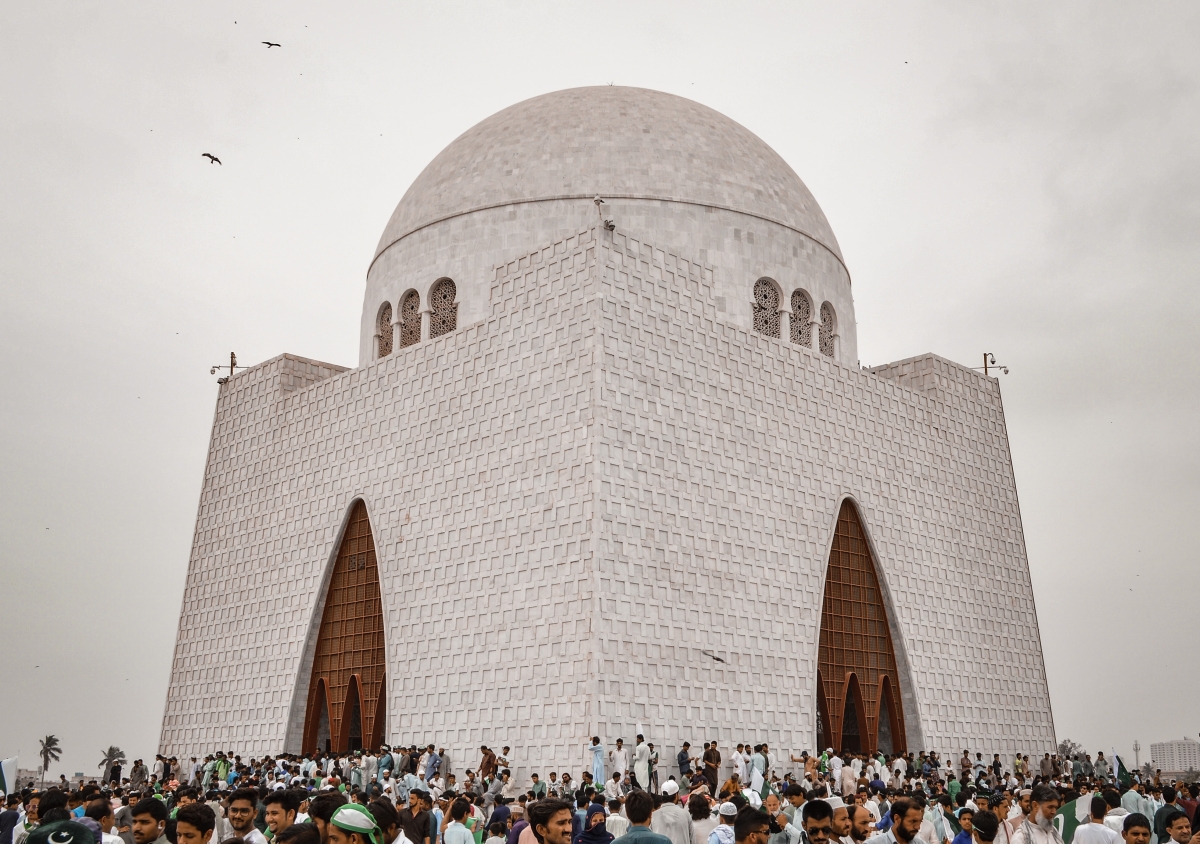
Tomb of Quaid e Azam Muhammad Ali Jinnah (Hassan Anwer/Unsplash)
Pakistan's short history as a country has been very turbulent. Fighting among the provinces--as well as a deep-rooted conflict that led to a nuclear stand-off with India—prevented Pakistan from gaining real stability in the last five decades. It oscillates between military rule and democratically elected governments, between secular policies and financial backing as a "frontline" state during the Cold War and the war against terrorism. Recent declared states of emergency and the political assassination of former Prime Minister Benazir Bhutto indicate a continuing trend of economic and political instability.
Overview
When Pakistan became a country on August 14th, 1947, to form the largest Muslim state in the world at that time. The creation of Pakistan was catalyst to the largest demographic movement in recorded history. Nearly seventeen million people-Hindus, Muslims, and Sikhs-are reported to have moved in both directions between India and the two wings of Pakistan (the eastern wing is now Bangladesh). Sixty million of the ninety-five million Muslims on the Indian subcontinent became citizens of Pakistan at the time of its creation. Subsequently, thirty-five million Muslims remained inside India making it the largest Muslim minority in a non-Muslim state.
Scarred from birth, Pakistan's quest for survival has been as compelling as it has been uncertain. Despite the shared religion of its overwhelmingly Muslim population, Pakistan has been engaged in a precarious struggle to define a national identity and evolve a political system for its linguistically diverse population. Pakistan is known to have over twenty languages and over 300 distinct dialects, Urdu and English are the official languages but Punjabi, Sindhi, Pashtu, Baluchi and Seraiki are considered main languages. This diversity has caused chronic regional tensions and successive failures in forming a constitution. Pakistan has also been burdened by full-scale wars with India, a strategically exposed northwestern frontier, and series of economic crises. It has difficulty allocating its scarce economic and natural resources in an equitable manner.
All of Pakistan's struggles underpin the dilemma they face in reconciling the goal of national integration with the imperatives of national security.
Following a military defeat at the hands of India the breakaway of its eastern territory, which India divides it from, caused the establishment of Bangladesh in 1971. This situation epitomizes the most dramatic manifestation of Pakistan's dilemma as a decentralized nation. Political developments in Pakistan continue to be marred by provincial jealousies and, in particular, by the deep resentments in the smaller provinces of Sind, Baluchistan, and the North-West Frontier Province against what is seen to be a monopoly by the Punjabi majority of the benefits of power, profit, and patronage. Pakistan's political instability over time has been matched by a fierce ideological debate about the form of government it should adopt, Islamic or secular. In the absence of any nationally based political party, Pakistan has long had to rely on the civil service and the army to maintain the continuities of government.
The Emergence of Pakistan
The roots of Pakistan's multifaceted problems can be traced to March 1940 when the All-India Muslim League formally orchestrated the demand for a Pakistan consisting of Muslim-majority provinces in the northwest and northeast of India. By asserting that the Indian Muslims were a nation, not a minority, the Muslim League and its leader, Mohammad Ali Jinnah, had hoped to negotiate a constitutional arrangement that provided an equitable share of power between Hindus and Muslims once the British relinquished control of India. The demand for a "Pakistan" was Jinnah's and the League's bid to register their claim to be the spokesmen of all Indian Muslims, both in provinces were they were in a majority as well as in provinces where they were a minority. Jinnah and the League's main bases of support, however, were in the Muslim-minority provinces. In the 1937 general elections, the league had met a serious rejection from the Muslim voters in the majority provinces.
There was an obvious contradiction in a demand for a separate Muslim state and the claim to be speaking for all Indian Muslims. During the remaining years of the British Raj in India neither Jinnah nor the Muslim League explained how Muslims in the minority provinces could benefit from a Pakistan based on an undivided Punjab, Sind, North-West Frontier Province, and Baluchistan in the northwest, and an undivided Bengal and Assam in the northeast. Jinnah did at least had tried to get around the inconsistencies by arguing that since there were two nations in India-Hindu and Muslim-any transfer of power from British to Indian hands would necessarily entail disbanding of the unitary center created by the imperial rulers. Reconstitution of the Indian union would have to be based on either confederal or treaty arrangements between Pakistan (representing the Muslim-majority provinces) and Hindustan (representing the Hindu-majority provinces). Jinnah also maintained that Pakistan would have to include an undivided Punjab and Bengal. The substantial non-Muslim minorities in both these provinces were the best guarantee that the Indian National Congress would see sense in negotiating reciprocal arrangements with the Muslim League to safeguard the interests of Muslim minorities in Hindustan.
Despite Jinnah's large claims, the Muslim League failed to build up effective party machinery in the Muslim-majority provinces. Consequently the league had no real control over either the politicians or the populace at the base that was mobilized in the name of Islam. During the final negotiations, Jinnah's options were limited by uncertain commitment of the Muslim-majority province politicians to the league's goals in the demand for Pakistan. The outbreak of communal troubles constrained Jinnah further still. In the end he had little choice but to settle for a Pakistan stripped of the non-Muslim majority districts of the Punjab and Bengal and to abandon his hopes of a settlement that might have secured the interests of all Muslims. But the worst cut of all was Congress's refusal to interpret partition as a division of India between Pakistan and Hindustan. According to the Congress, partition simply meant that certain areas with Muslim majorities were 'splitting off' from the "Indian union." The implication was that if Pakistan failed to survive, the Muslim areas would have to return to the Indian union; there would be no assistance to recreate it on the basis of two sovereign states.
With this agreement nothing stood in the way of the reincorporation of the Muslim areas into the Indian union except the notion of a central authority, which had yet to be firmly established. To establish a central authority proved to be difficult, especially since the provinces had been governed from New Delhi for so long and the separation of Pakistan's eastern and western wings by one thousand miles of Indian territory. Even if Islamic sentiments were the best hope of keeping the Pakistani provinces unified, their pluralistic traditions and linguistic affiliations were formidable stumbling blocks. Islam had certainly been a useful rallying cry, but it had not been effectively translated into the solid support that Jinnah and the League needed from the Muslim provinces in order to negotiate an arrangement on behalf of all Indian Muslims.
The diversity of Pakistan's provinces, therefore, was a potential threat to central authority. While the provincial arenas continued to be the main centers of political activity, those who set about creating the centralized government in Karachi were either politicians with no real support or civil servants trained in the old traditions of British Indian administration. The inherent weaknesses of the Muslim League's structure, together with the absence of a central administrative apparatus that could coordinate the affairs of the state, proved to be a crippling disadvantage for Pakistan overall. The presence of millions of refugees called for urgent remedial action by a central government that, beyond not being established, had neither adequate resources nor capacities. The commercial groups had yet to invest in some desperately needed industrial units. And the need to extract revenues from the agrarian sector called for state interventions, which caused a schism between the administrative apparatus of the Muslim League and the landed elite who dominated the Muslim League.
Power and Governance
Both the military and the civil bureaucracy were affected by the disruptions wrought by partition. Pakistan cycled through a number of politicians through their beginning political and economic crises. The politicians were corrupt, interested in maintaining their political power and securing the interests of the elite, so to have them as the representative authority did not provide much hope of a democratic state that provided socio-economic justice and fair administration to all Pakistani citizens. Ranging controversies over the issue of the national language, the role of Islam, provincial representation, and the distribution of power between the center and the provinces delayed constitution making and postponed general elections. In October 1956 a consensus was cobbled together and Pakistan's first constitution declared. The experiment in democratic government was short but not sweet. Ministries were made and broken in quick succession and in October 1958, with national elections scheduled for the following year, General Mohammad Ayub Khan carried out a military coup with confounding ease.
Between 1958 and 1971 President Ayub Khan, through autocratic rule was able to centralize the government without the inconvenience of unstable ministerial coalitions that had characterized its first decade after independence. Khan brought together an alliance of a predominantly Punjabi army and civil bureaucracy with the small but influential industrial class as well as segments of the landed elite, to replace the parliamentary government by a system of Basic Democracies. Basic Democracies code was founded on the premise of Khan's diagnosis that the politicians and their "free-for-all" type of fighting had had ill effect on the country. He therefore disqualified all old politicians under the Elective Bodies Disqualification Order, 1959 (EBDO). The Basic Democracies institution was then enforced justifying "that it was democracy that suited the genius of the people." A small number of basic democrats (initially eighty thousand divided equally between the two wings and later increased by another forty thousand) elected the members of both the provincial and national assemblies. Consequently the Basic Democracies system did not empower the individual citizens to participate in the democratic process, but opened up the opportunity to bribe and buy votes from the limited voters who were privileged enough to vote.
By giving the civil bureaucracy (the chosen few) a part in electoral politics, Khan had hoped to bolster central authority, and largely American-directed, programs for Pakistan's economic development. But his policies exacerbated existing disparities between the provinces as well as within them. Which gave the grievances of the eastern wing a potency that threatened the very centralized control Khan was trying to establish. In West Pakistan, notable successes in increasing productivity were more than offset by growing inequalities in the agrarian sector and their lack of representation, an agonizing process of urbanization, and the concentration of wealth in a few industrial houses. In the aftermath of the 1965 war with India, mounting regional discontent in East Pakistan and urban unrest in West Pakistan helped undermine Ayub Khan's authority, forcing him to relinquish power in March 1969.
Bangladesh Secedes
After Ayub Khan, General Agha Muhammad Yahya Khan headed the second military regime from 1969-1971. By that time the country had been under military rule for thirteen of its twenty-five years of existence. This second military regime emphasized the extent to which the process of centralization under bureaucratic and military tutelage had fragmented Pakistani society and politics. The general elections of 1970 on the basis of adult franchise revealed for the first time ever in Pakistan's history how regionalism and social conflict had come to dominate politics despite the efforts at controlled development. The Awami League, led by Mujibur Rahman, campaigned on a six-point program of provincial autonomy, capturing all but one seat in East Pakistan and securing an absolute majority in the national assembly. In West Pakistan the Pakistan People's Party, led by Zulfiqar Ali Bhutto, had a populist platform that stole the thunder from the Islamic parties (the Muslim League, the oldest political party captured no more than a few seats) and emerged as the largest single bloc. The prospect of an Awami Leagues government was a threat to politicians in West Pakistan who in conspiracy with the military leadership prevented Mujibur from taking the reins of power. This was the final straw for the east wing who was already fed up with the their under-representation in all sectors of the government, economic deprivation and then the suppression of the democratic process. An armed rebellion in East Pakistan engendered all of these frustrations, which caused Indian military intervention to crush it. Pakistan was now involved in its third war with India, thus clearing the way for the establishment of Bangladesh in 1971.
A Democratic Government
The dismemberment of Pakistan discredited both the civil bureaucracy and the army, General Yahya Khan was left no choice but to hand all power over to the Pakistan's People's Party (PPP) who saw the formation of a representative led by Zulfikar Ali Bhutto. Bhutto's electoral strength, however, was confined to the Punjab and Sind, and even there it had not been based on solid political party organization. This, together with the PPP's lack of following in the North-West Frontier Province and Baluchistan, meant that Bhutto could not work the central apparatus without at least the implicit support of the civil bureaucracy and the military high command. The 1973 constitution made large concessions to the non-Punjabi provinces and provided the blueprint for a political system based on the semblance of a national consensus. But Bhutto failed to implement the federal provisions of the constitution. He relied on the coercive arm of the state to snuff out political opposition and by neglecting to build the PPP as a truly popular national party. The gap between his popular rhetoric and the marginal successes of his somewhat haphazard economic reforms prevented Bhutto form consolidating a social base of support. Thus, despite a temporary loss of face in 1971 the civil bureaucracy and the army remained the most important pillars of the state structure, instead of the citizens of Pakistan who were still struggling to be recognized in the democratic process. Although Bhutto's PPP won the 1977 elections, the Pakistan National Alliance-a nine-party coalition-charged him with rigging the vote. Violent urban unrest gave the army under General Zia-ul Haq the pretext to make a powerful comeback to the political arena, and on July 5, 1977 Pakistan was placed under military rule yet again and the 1973 Constitution was suspended.
Upon assuming power General Zia banned all political parties and expressed his determination to recast the Pakistani state and society into an Islamic mold. In April 1979 Bhutto was executed on murder charges and the PPP's remaining leadership was jailed or exiled. By holding nonparty elections and initiating a series of Islamization policies, Zia sought to create a popular base of support in the hope of legitimizing the role of the military in Pakistani politics. The Soviet invasion of Afghanistan in December 1979 caused Zia's regime to receive international support as a stable government bordering Soviet territory. Although Pakistan had now formally disentangled its self from both SEATO and CENTO and joined the nonaligned movement, was regarded by the West as an important front-line state and is a major recipient of American military and financial aid. Despite a string of statistics advertising the health of the economy, murmurs of discontent, though muffled, continued to be heard. On December 30, 1985, after confirming his own position in a controversial "Islamic" referendum, completing a fresh round of nonparty elections of the provincial and national assemblies, and introducing a series of amendments to the 1973 constitution, Zia finally lifted martial law and announced the dawn of a new democratic era in Pakistan.
This new democratic era was just as turbulent as Pakistan's previous political history. Major political parties called for a boycott the 1985 election due to the non-party bias platform. In absence of political parties the candidates focused on local issues that superseded the majority of the candidates affiliations to particular parties. The Pakistani people were obviously interested in participating in the democratic process and disregarded the urge to boycott, 52.9% cast ballots for the National Assembly and 56.9% cast ballots for the provincial elections.
President Zia first initiative was to introduce amendments to the 1973 constitution that would secure his power over the parliamentary system. The eighth amendment turned out to be the most detrimental to the people's faith in the democratic system. Now the president could possess complete control and power to take any step, which he felt was necessary to secure national integrity. For the next twelve years the presidents used this amendment to expel a number of prime ministers from their post, mainly due to either personal struggles or insecurity over shift in power.
Following the 1988 election, Muhammad Khan Junejo was nominated as the prime minister, who had a unanimous vote of confidence by the National Assembly. Junejo seemed to be a promising component to the Pakistani government; he fostered a smooth transition from the army to civil authority, which generated optimism about the democratic process of Pakistan. For the first of his years in office, Junejo was able to strike a balance between establishing the parliamentary credentials as a democratic body and maintaining President Zia's blessing. He developed the five-point program that aimed at improving development, literacy rate, eliminating corruption and improvement of the common man's lot. He was as well improving foreign policy abroad and was grappling a major budgetary deficit from the heavy expenditure of the martial law regimes. But on May 29th 1988 President Zia dissolved the National Assembly and removed the prime minister under the article 58-2-b of the Constitution. He claimed that Jenejo was conspiring against him in order to undermine his position; he blamed the National Assembly of corruption and failure to enforce Islamic way of life.
The opposition parties were in support of Zia's decision because it worked in their benefit, providing an early election. They demanded elections to be schedule in ninety days in accordance with the constitution. President Zia interpreted this article of the constitution differently. He felt he was required to announce the election schedule in ninety days while the elections could be held later. Simultaneously he wanted to hold the elections on a non-party basis as he had in 1985, but the Supreme Court upheld that this went against the spirit of the constitution. Political confusion ensued as a result of Zia's proposal to postpone the elections to re-structure the political system in the name of Islam. There was fear that Zia may impose martial law and the Muslim League became split between supporters of Zia and Junejo. All of this was stalled when Zia died in a plane crash on august 17th.
Ghulam Ishaq Khan was sworn in as president being the chairman of the Senate and elections were initiated. Which surprised to outside observers who feared that the military could easily take over power. The November elections of 1988 were based on political party platforms for the first time in fifteen years. None of the parties won the majority of the National Assembly but the Pakistan People's Party emerged as the single largest holder of seats. Benazir Bhutto, the PPP's chairperson, was named prime minister after the PPP formed a coalition of smaller parties to form a working majority. At first people were hopeful that Bhutto would work together with the opposition party's leader Nawaz Sharif of the IJI party, who headed the Punjabi party, the majority province. But soon they escalated bitterness to new heights and drained the economy with bribes to other politicians to sway affiliations. These accounts plus no improvement on the economic front scarred the central government's image. In 1990 the President dismissed Bhutto under the eighth amendment of the constitution, a decision upheld by the Supreme Court. So once again elections were held a short two years later.
The Pakistani people were losing faith in the democratic system. They felt it was corrupt, haphazard and based on the squabbles of the military and bureaucratic elite. This attitude was reinforced by the fact that Nawaz Sharif was assigned prime minister in 1990, and dismissed in 1993 even though he had liberalized investment, restored confidence of domestic and international investors, so that investment increased by 17.6%. And as a result the GDP had a growth rate of 6.9% while the inflation stayed under 10%. President Ghulam Ishaq Khan was accused of conspiring with Benazir Bhutto in the dismissal of Sharif. For the first time in Pakistan's history the Supreme Court declared that the dismissal of the National Assembly and Sharif unconstitutional, reinstating Sharif and the National Assembly. This act showed that the president was not the overriding power but the events that followed proved how unstable the government was. Through bribes and palace intrigues Ghulam was able to influence a rebellion in Punjab in 1993, which represented Sharif and his party as incompetent. This situation caused an upheaval in the system that resulted in intervention of the chief of Army Staff General, Abdul Waheed Kaker. It was agreed that both the president and prime minister would resign and new elections would be arranged.
An even lower turn out affected the legitimacy of the all too frequent electoral process. In this election the mandate was divided by the same players, the PPP with Bhutto and the Muslim League with Sharif. Sharif had lost the popular support in Punjab, which caused the PPP to claim the majority of the seats. So once again the PPP claimed the majority of the seats and Bhutto was placed as prime minister. She was able to get Farooq Ahmad Khan Leghari elected as president, which secured her government against the eighth amendment. Regardless Bhutto was unable to run a just government; she fell back into corruption, misuses of state resources, which was detrimental to the Pakistani people. Both the Chief Justice and President wanted to maintain the autonomy of their position in the government, while Bhutto was attempting to override the political system. President Leghari soon dismissed her with the support of the Supreme Court. The public hailed this decision and in February 1997 prepared for new elections, the fifth in twelve years. The voter support for the elections waned proportionately throughout these twelve years.
It was obvious that the two leading parties were alternating public support when Sharif and the Muslim League were reinstated as the Prime Minister and majority party respectively. The Muslim League used its parliamentary majority to enact a fundamental change in the political system with the introduction of amendments thirteen in the constitution. The thirteenth amendment limited the power of the president to that of a nominal head of state, while restoring the parliament as the central governmental power. This amendment basically created a check and balance procedure to article eight, in an attempt to maintain political stability. By 1999 the eighth amendment was stripped of the constraints that empowered the president to dissolve the National Assembly or dismiss the prime minister. These legislative feats were impressive, but overall the Muslim League's performance was mixed. They inherited a lot of obstacles, an economy that was on the verge of collapse and a political culture of corruption. The May 1998 decision to conduct nuclear tests in response to India's nuclear tests resulted in the imposition of sanctions that stifled the economy even more so. Bhutto's corrupt usage of foreign funds and the freezing of foreign investments further complicated investment relations.
Turmoil
Prime Minister Sharif was gaining disapproval on many fronts, for he was perceived to be power hungry and possibly corrupt. He had forced out the chief justice of the supreme court and the army chief soon after the eighth amendment was revised, he was cracking down on the press that did not support him and his family's firm, Ittefaq Industries, was doing abnormally well in times of economic slowdown, which led to suspicions of corruption. The army chief, Jehangir Karamat was among the many who were worried about Sharif's mounting power, he demanded that the army be included in the country's decision-making process in attempt to balance the civil government. Two days later he resigned putting General Pervez Musharraf in his position. Musharraf had been one of the principal strategists in the Kashmiri crisis with India. He soon suspected that he did not have the political backing of the civil government in his aggressive quest in Kashmir. The combination of Shariff's reluctance in the Kashmiri opposition, mounting factional disputes, terrorism all provided Musharraf with the justification to lead a coup to overthrow the civil government. On October 12th, 1999 he successfully ousted Sharif and the Muslim League on the grounds that he was maintaining law and order while strengthening the institution of governance.
The Pakistani people thought that this may be on a temporary basis and once things had stabilized, Musharraf would call for new elections of the National Assembly. But Musharraf has refused to reinstate the National Assembly via elections until October 2002, a deadline set by the Supreme Court. In July of 2001 Musharraf declared himself president before meeting with the Indian prime minister to legitimize his authority within the Pakistani government. He has since recalled all regional militant Islamic factions through out Pakistan and encouraged them to return their weapons to the central government. He has been unwavering on Pakistan's position on Kashmir, which resulted in shortening talks with India. He is now cooperating with the American government and western world in the coalition against terrorism, which puts him in an awkward position with his Afghanistan neighbors and the fractious groups within Pakistan who sympathize with the Taliban and Osama Bin Laden on an ethnic, ideological and political level.
Mohammad Ali Jinnah had always envisioned a democratic Pakistan and many of his successors have struggle towards this goal, but not more than maintaining their own platforms of power. It is ironic that such political instability plagues a country whose number one objective of its leaders is to secure their own power. Maybe it is time for a new equation. The actions of both civil and military leaders have exhaustively tried the Pakistani people and their struggle as a nation. Pakistan faces the unenviable task of setting government priorities in accordance with the needs of its diverse and unevenly developed constituent units. Regardless of the form of government--civilian or military, Islamic or secular--solutions of the problem of mass illiteracy and economic inequities on the one hand, and the imperatives of national integration and national security will also determine the degree of political stability, or instability, that Pakistan faces in the decades ahead. But the people and the nation persevere offering the world great cultural, religious, and intellectual traditions
Based on Ayesha Jalal for for the Encyclopedia of Asian History, adapted by Amanda Snellinger. © Asia Society. From The Encyclopedia of Asian History. Asia Society and Charles Scribner's Sons.
Discover More About Pakistan
Comments
Post a Comment